
FITC Anti-Human CD86 Antibody[BU63]
| Cat Number: | MAB1012C |
|---|---|
| Conjugate: | FITC |
| Size: | 100 tests |
| Clone: | BU63 |
| Host: | Mouse |
| Isotype: | Mouse IgG1, κ |
| Reactivity: | Human |
| Applications: | FCM Each lot of this antibody is quality control tested by flow cytometric analysis. The amount of the reagent is suggested to be used 5 µL of antibody per test (million cells in 100 µL staining volume or per 100 µL of whole blood). Please check your vial before the experiment. Since applications vary, the appropriate dilutions must be determined for individual use. |
| Molecular: | 80 kD |
| Synonyms: | Activation B7-2 antigen;Cd86;ETC-1;Early T-cell costimulatory molecule 1;T-lymphocyte activation antigen CD86 |
| Background: | CD86 is an 80 kD immunoglobulin superfamily member also known as B7-2, B70, and Ly-58. CD86 is expressed on activated B and T cells, monocytes/macrophages, dendritic cells, and astrocytes. CD86, along with CD80, is the ligand of CD28 and CD152 (CTLA-4). CD86 is expressed earlier in the immune response than CD80. CD86 has also been shown to be involved in immunoglobulin class-switching and triggering of NK cell-mediated cytotoxicity. CD86 binds to CD28 to transduce costimulatory signals for T cell activation, proliferation, and cytokine production. CD86 can bind to CD152 as well, also known as CTLA-4, to deliver an inhibitory signal to T cells. |
| Form: | Liquid |
| Buffer: | Phosphate buffered solution, pH 7.2, containing 0.09% stabilizer. |
| Storage: | Keep as concentrated solution. This product can be stored at 2-8°C for 24 months. Please protected from prolonged exposure to light and do not freeze. |
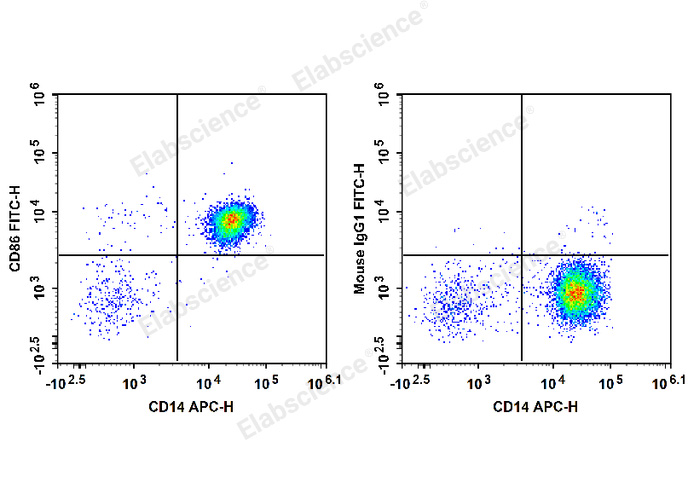
Staining of normal human peripheral blood cells with Anti-Human CD14 APC and Anti-Human CD86 FITC (left) or Mouse IgG1, κ Isotype Control FITC (right). Cells in the monocyte gate were used for analysis.