
GluR-1 Rabbit Polyclonal Antibody
| Cat Number: | ABN11491 |
|---|---|
| Conjugate: | Unconjugated |
| Size: | 100ul |
| Clone: | POLY |
| Concentration: | 1mg/ml |
| Host: | Rabbit |
| Isotype: | IgG |
| Immunogen: | The antiserum was produced against synthesized peptide derived from human GluR1. AA range:816-865 |
| Reactivity: | Human,Mouse,Rat |
| Applications: | WB 1:500-1:2000,IHC 1:100-1:300,ICC/IF 1:200-1:1000,ELISA 1:20000-1:40000 |
| Molecular: | 95kDa |
| Purification: | Affinity purification |
| Synonyms: | GRIA1; GLUH1; GLUR1; Glutamate receptor 1; GluR-1; AMPA-selective glutamate receptor 1; GluR-A; GluR-K1; Glutamate receptor ionotropic; AMPA 1; GluA1 |
| Background: | Glutamate receptors are the predominant excitatory neurotransmitter receptors in the mammalian brain and are activated in a variety of normal neurophysiologic processes. These receptors are heteromeric protein complexes with multiple subunits, each possessing transmembrane regions, and all arranged to form a ligand-gated ion channel. The classification of glutamate receptors is based on their activation by different pharmacologic agonists. This gene belongs to a family of alpha-amino-3-hydroxy-5-methyl-4-isoxazole propionate (AMPA) receptors. Alternatively spliced transcript variants encoding different isoforms have been found for this gene. [provided by RefSeq, Jul 2008],function:Ionotropic glutamate receptor. L-glutamate acts as an excitatory neurotransmitter at many synapses in the central nervous system. Binding of the excitatory neurotransmitter L-glutamate induces a conformation change, leading to the opening of the cation channel, and thereby converts the chemical signal to an electrical impulse. The receptor then desensitizes rapidly and enters a transient inactive state, characterized by the presence of bound agonist.,miscellaneous:The postsynaptic actions of Glu are mediated by a variety of receptors that are named according to their selective agonists. This receptor binds AMPA (quisqualate) > glutamate > kainate.,PTM:Palmitoylated. Depalmitoylated upon glutamate stimulation. Cys-603 palmitoylation leads to Golgi retention and decreased cell surface expression. In contrast, Cys-829 palmitoylation does not affect cell surface expression but regulates stimulation-dependent endocytosis.,similarity:Belongs to the glutamate-gated ion channel (TC 1.A.10) family.,subcellular location:Interaction with CACNG2 promotes cell surface expression.,subunit:Homotetramer or heterotetramer of pore-forming glutamate receptor subunits. Tetramers may be formed by the dimerization of dimers. Interacts with DLG1 via its C-terminus. Interacts with CACNG2, HIP1 and RASGRF2.,tissue specificity:Widely expressed in brain., |
| Form: | Liquid |
| Buffer: | Liquid in PBS containing 50% glycerol, 0.5% protective protein and 0.02% New type preservative N. |
| Storage: | Store at 4°C short term. Aliquot and store at -20°C long term. Avoid freeze/thaw cycles. |
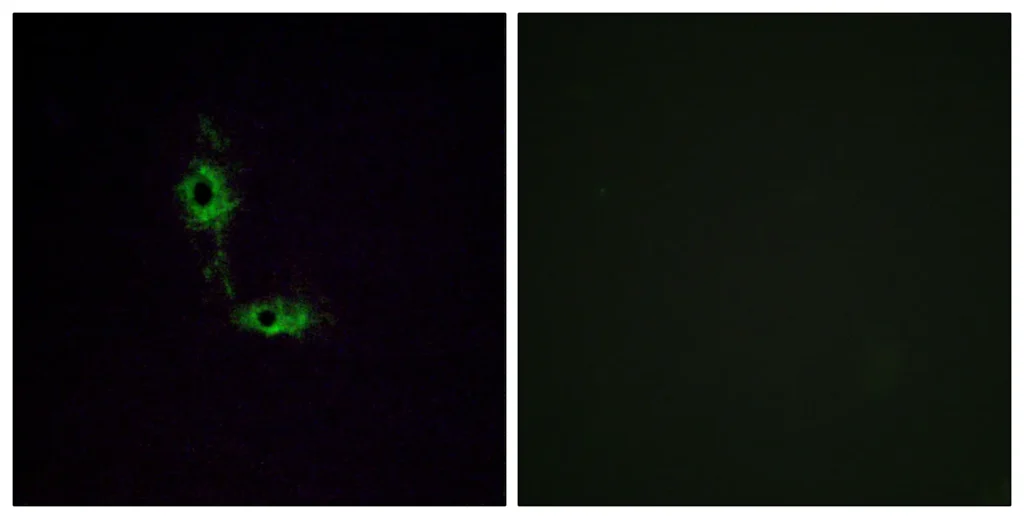
Immunofluorescence analysis of HeLa cells, using GluR1 Antibody. The picture on the right is blocked with the synthesized peptide.
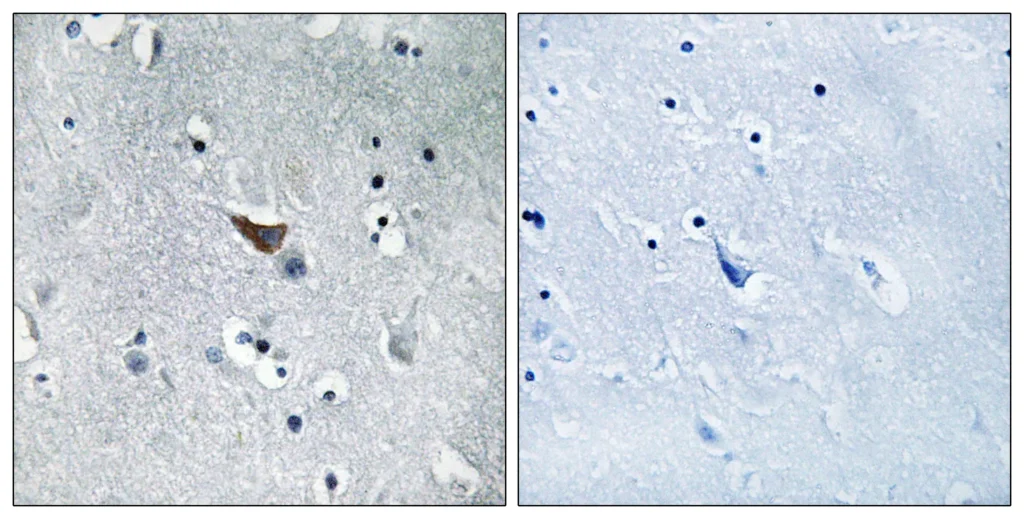
Immunohistochemistry analysis of paraffin-embedded human brain tissue, using GluR1 Antibody. The picture on the right is blocked with the synthesized peptide.
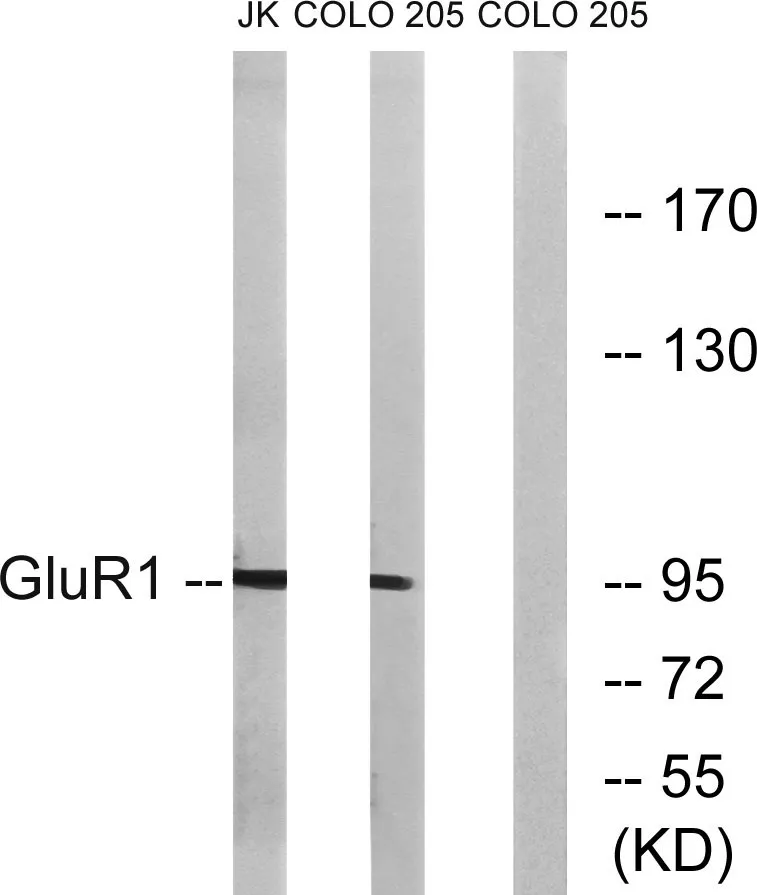
Western blot analysis of lysates from COLO and Jurkat cells, using GluR1 Antibody. The lane on the right is blocked with the synthesized peptide.