
NMDAζ1 (phospho Ser896) Rabbit Polyclonal Antibody
| Cat Number: | ABN05118 |
|---|---|
| Conjugate: | Unconjugated |
| Size: | 200μL |
| Clone: | POLY |
| Concentration: | 1mg/ml |
| Host: | Rabbit |
| Isotype: | IgG |
| Immunogen: | Phosphopeptide (Phospho-left) and Non-Phosphopeptide (Phospho-right), using NMDAR1 (Phospho-Ser896) Antibody Immunohistochemistry analysis of paraffin-embedded human brain, using NMDAR1 (Phospho-Ser896) Antibody. The picture on the right is blocked with the phospho peptide. |
| Reactivity: | Human,Mouse,Rat |
| Applications: | WB 1:500-1:2000,IHC 1:100-1:300,ICC/IF 1:50-1:200,ELISA 1:20000-1:40000 |
| Molecular: | 105kDa |
| Purification: | Affinity purification |
| Synonyms: | GRIN1; NMDAR1; Glutamate [NMDA] receptor subunit zeta-1; N-methyl-D-aspartate receptor subunit NR1; NMD-R1 |
| Background: | The protein encoded by this gene is a critical subunit of N-methyl-D-aspartate receptors, members of the glutamate receptor channel superfamily which are heteromeric protein complexes with multiple subunits arranged to form a ligand-gated ion channel. These subunits play a key role in the plasticity of synapses, which is believed to underlie memory and learning. Cell-specific factors are thought to control expression of different isoforms, possibly contributing to the functional diversity of the subunits. Alternatively spliced transcript variants have been described. [provided by RefSeq, Jul 2008],function:NMDA receptor subtype of glutamate-gated ion channels with high calcium permeability and voltage-dependent sensitivity to magnesium. Mediated by glycine. This protein plays a key role in synaptic plasticity, synaptogenesis, excitotoxicity, memory acquisition and learning. It mediates neuronal functions in glutamate neurotransmission. Is involved in the cell surface targeting of NMDA receptors.,online information:NMDA receptor entry,PTM:NMDA is probably regulated by C-terminal phosphorylation of an isoform of NR1 by PKC. Dephosphorylated on Ser-897 probably by protein phosphatase 2A (PPP2CB). Its phosphorylated state is influenced by the formation of the NMDAR-PPP2CB complex and the NMDAR channel activity.,similarity:Belongs to the glutamate-gated ion channel (TC 1.A.10) family.,subcellular location:Enriched in post-synaptic plasma membrane and post-synaptic densities.,subunit:Forms heteromeric channel of a zeta subunit (GRIN1), a epsilon subunit (GRIN2A, GRIN2B, GRIN2C or GRIN2D) and a third subunit (GRIN3A or GRIN3B); disulfide-linked. Found in a complex with GRIN2A or GRIN2B, GRIN3A or GRIN3B and PPP2CB. Interacts with DLG4 and MPDZ., |
| Form: | liquid |
| Buffer: | Liquid in PBS containing 50% glycerol, 0.5% protective protein and 0.02% New type preservative N. |
| Storage: | Store at 4°C short term. Aliquot and store at -20°C long term. Avoid freeze/thaw cycles. |
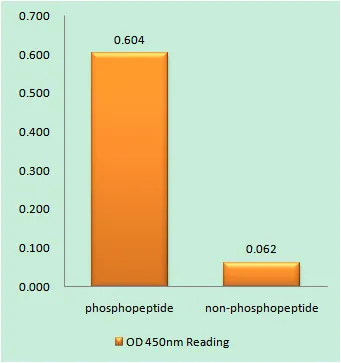
Enzyme-Linked Immunosorbent Assay (Phospho-ELISA) for Immunogen Phosphopeptide (Phospho-left) and Non-Phosphopeptide (Phospho-right), using NMDAR1 (Phospho-Ser896) Antibody
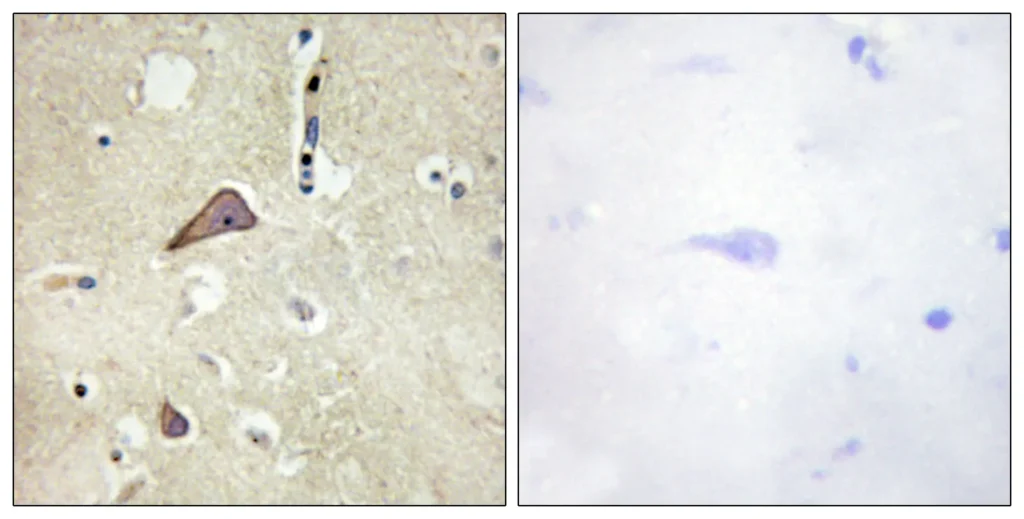
Immunohistochemistry analysis of paraffin-embedded human brain, using NMDAR1 (Phospho-Ser896) Antibody. The picture on the right is blocked with the phospho peptide.
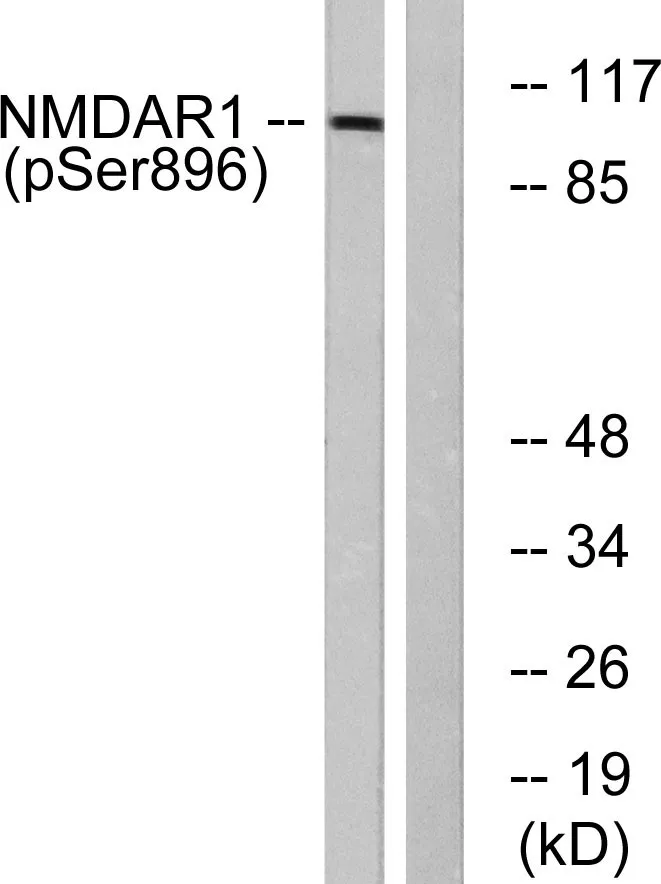
Western blot analysis of lysates from K562 cells treated with PMA 125ng/ml 30′, using NMDAR1 (Phospho-Ser896) Antibody. The lane on the right is blocked with the phospho peptide.