
Arrestin-β-1 Rabbit Polyclonal Antibody
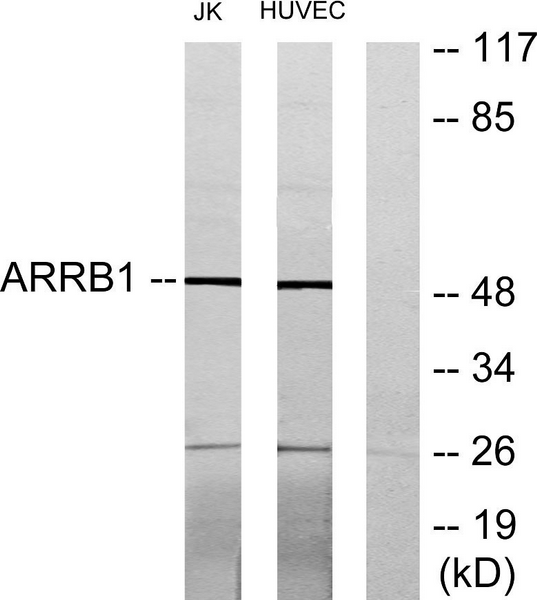
Western blot analysis of lysates from Jurkat and HUVEC cells, using ARRB1 Antibody. The lane on the right is blocked with the synthesized peptide.
| Catalog Number: | AB-82194 |
| Conjugate: | Unconjugated |
| Size: | 100 ug |
| Concentration: | 1mg/ml |
| Host: | Rabbit |
| Isotype: | IgG |
| Immunogen: | The antiserum was produced against synthesized peptide derived from human ARRB1. AA range:369-418 |
| Reactivity: | Human,Mouse,Rat |
| Applications: | WB 1:500-1:2000,IHC 1:100-1:300,ICC/IF 1:200-1:1000,ELISA 1:5000-1:20000 |
| Molecular Weight: | 50kDa |
| Purification: | Affinity purification |
| Form: | Liquid |
| Synonyms: | ARRB1; ARR1; Beta-arrestin-1; Arrestin beta-1 |
Members of arrestin/beta-arrestin protein family are thought to participate in agonist-mediated desensitization of G-protein-coupled receptors and cause specific dampening of cellular responses to stimuli such as hormones, neurotransmitters, or sensory signals. Arrestin beta 1 is a cytosolic protein and acts as a cofactor in the beta-adrenergic receptor kinase (BARK) mediated desensitization of beta-adrenergic receptors. Besides the central nervous system, it is expressed at high levels in peripheral blood leukocytes, and thus the BARK/beta-arrestin system is believed to play a major role in regulating receptor-mediated immune functions. Alternatively spliced transcripts encoding different isoforms of arrestin beta 1 have been described. [provided by RefSeq, Jan 2011],function:Regulates beta-adrenergic receptor function. Beta-arrestins seem to bind phosphorylated beta-adrenergic receptors, thereby causing a significant impairment of their capacity to activate G(S) proteins.,online information:Arrestin entry,similarity:Belongs to the arrestin family.
Applications
WB 1:500-1:2000,IHC 1:100-1:300,ICC/IF 1:200-1:1000,ELISA 1:5000-1:20000
Immunogen
The antiserum was produced against synthesized peptide derived from human ARRB1. AA range:369-418