
Caspase-1
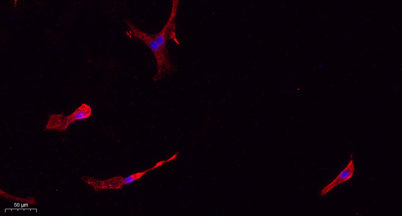
Immunofluorescence analysis of A549. 1,primary Antibody(red) was diluted at 1:200(4°C overnight). 2, Goat Anti Rabbit IgG (H&L) - Alexa Fluor 594 Secondary antibody was diluted at 1:1000(room temperature, 50min).3, Picture B: DAPI(blue) 10min.
| Catalog Number: | ABE8461 |
| Conjugate: | Unconjugated |
| Size: | 100ug |
| Concentration: | 1mg/ml |
| Host: | Rb |
| Isotype: | IgG |
| Clone: | POLY |
| Immunogen: | The antiserum was produced against synthesized peptide derived from the C-terminal region of human CASP1. AA range:350-400 |
| Reactivity: | Hu,Ms,Rt |
| Applications: | IF,WB,IHC,ELISA |
| Molecular Weight: | 45kD |
| Purification: | Affinity Purified |
| Form: | Liquid |
This gene encodes a protein which is a member of the cysteine-aspartic acid protease (caspase) family. Sequential activation of caspases plays a central role in the execution-phase of cell apoptosis. Caspases exist as inactive proenzymes which undergo proteolytic processing at conserved aspartic residues to produce 2 subunits, large and small, that dimerize to form the active enzyme. This gene was identified by its ability to proteolytically cleave and activate the inactive precursor of interleukin-1, a cytokine involved in the processes such as inflammation, septic shock, and wound healing. This gene has been shown to induce cell apoptosis and may function in various developmental stages. Studies of a similar gene in mouse suggest a role in the pathogenesis of Huntington disease. Alternative splicing results in transcript variants encoding distinct isoforms. [provided by RefSeq, Mar 2012],
Applications
IF,WB,IHC,ELISA
Immunogen
The antiserum was produced against synthesized peptide derived from the C-terminal region of human CASP1. AA range:350-400