
GluR1 (12Y10) Rabbit Monoclonal Antibody
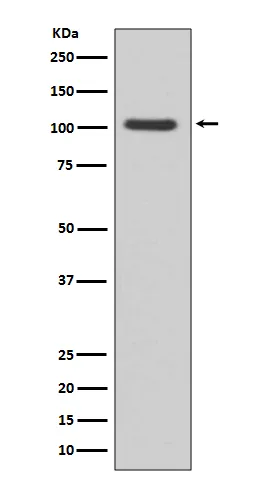
Western blot analysis of GluR1 expression in Human brain lysate.
| Catalog Number: | MABN11490 |
| Conjugate: | Unconjugated |
| Size: | 100μL |
| Concentration: | 1mg/ml |
| Host: | Rabbit |
| Isotype: | IgG |
| Clone: | Monoclonal |
| Immunogen: | A synthetic peptide of human Glutamate Receptor 1 (AMPA subtype) |
| Reactivity: | Human,Mouse,Rat |
| Applications: | WB 1:500-1:2000,IP 1:10-1:100 |
| Molecular Weight: | 102kDa |
| Purification: | Affinity purification |
| Form: | Liquid |
| Synonyms: | Glutamate receptor 1; GluR-1; AMPA-selective glutamate receptor 1; GluR-A; GluR-K1; GluRA; GluRK1; Glutamate receptor ionotropic, AMPA 1; GluA1; GRIA1; GLUH1; GLUR1; |
AMPA- (α-amino-3-hydroxy-5-methyl-4-isoxazolepropionic acid), kainate-, and NMDA- (N-methyl-D-aspartate) receptors are the three main families of ionotropic glutamate-gated ion channels. AMPA receptors (AMPARs) are comprised of four subunits (GluR 1-4), which assemble as homo- or hetero-tetramers to mediate the majority of fast excitatory transmissions in the central nervous system. AMPARs are implicated in synapse formation, stabilization, and plasticity. Ionotropic glutamate receptor. L-glutamate acts as an excitatory neurotransmitter at many synapses in the central nervous system. Binding of the excitatory neurotransmitter L-glutamate induces a conformation change, leading to the opening of the cation channel, and thereby converts the chemical signal to an electrical impulse. The receptor then desensitizes rapidly and enters a transient inactive state, characterized by the presence of bound agonist. In the presence of CACNG4 or CACNG7 or CACNG8, shows resensitization which is characterized by a delayed accumulation of current flux upon continued application of glutamate.
Applications
WB 1:500-1:2000,IP 1:10-1:100
Immunogen
A synthetic peptide of human Glutamate Receptor 1 (AMPA subtype)