
JNK

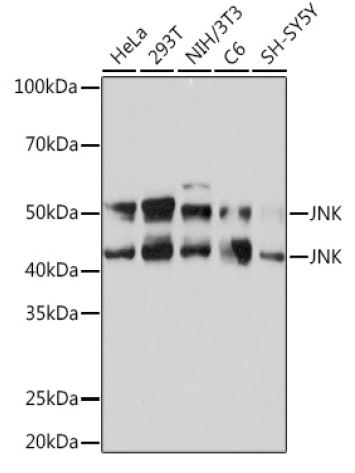
Western blot analysis of extracts of various cell lines,
using JNK1/2/3 Rabbit mAb at 1:1000 dilution.
Secondary antibody: HRP Goat Anti-Rabbit IgG (H+L)
at 1:10000 dilution.
Lysates/proteins: 25ug per lane.
Blocking buffer: 3% nonfat dry milk in TBST.
Detection: ECL West Pico Plus.
Exposure time: 30s.

Western blot analysis of extracts of various cell lines, using JNK1/2/3 Rabbit mAb at 1:1000 dilution. Secondary antibody: HRP Goat Anti-Rabbit IgG (H+L) at 1:10000 dilution. Lysates/proteins: 25ug per lane. Blocking buffer: 3% nonfat dry milk in TBST. Detection: ECL West Pico Plus. Exposure time: 30s.

Catalog Number:MAB-94638
Size:100 ug
Concentration:1mg/ml
Host:Rb
Isotype:IgG
Clone:81E11
Immunogen:A synthesized peptide derived from human JNK
Reactivity:Hu, Ms, Rt
Applications:Western Blot: 1:1000 Immunofluorescence: 1:50 - 1:200
Molecular Weight:46, 54 kDa
Purification:Monoclonal Antibodies are produced by immunizing animals with a recombinant human JNK2 fusion protein. Antibodies are purified by protein A and peptide affinity chromatography.
Form:Liquid

Applications

Western Blot: 1:1000 Immunofluorescence: 1:50 - 1:200

Immunogen

A synthesized peptide derived from human JNK
Target Background

The stress-activated protein kinase/Jun-aminoterminal kinase SAPK/JNK is potently and preferentialiy activated by a variety of environmental stresses including UV and gamma radiation, ceramides, inflammatory cytokines, and in some instances, growth factors and GPCR agonists (1-6). As with the other MAPKs, the core signaling unii is composed of a MAPKKK, typically MEKK1-MEKK4, or by one of the mixed lineage kinases (MLKs}, which phosphorylate and activate MKK4/7. Upon activation, MKKs phosphorylate and activate the SAPK/JNK kinase (2). Stress signals are delivered to this cascade by small GTPases of the Rho family (Rac, Rho, cdc42) (3). Both Rac1 and cdc42 mediate the stimulation of MEKKs and MLKs (3). Alternatively, MKK4/7 can be activated in a GTPase-independent mechanism via stimulation of a germinai center kinase (GCK} family member (4). There are three SAPK/JNK genes each of which undergoes alternative splicing, resulting in numerous isoforms (3). SAPK/JNK, when active as a dimer, can translocate to the nucleus and regulate transcription through its effects on c-Jun, ATF-2, and other transcription factors (3,5). SAPK/JNK Antibody detects endogenous levels of total JNK1, JNK2 or JNK3 protein.

Storage

Store at -20. Avoid freeze / thaw cycles.

Buffer

PBS with 0.02% sodium azide,0.05% BSA,50% glycerol,pH7.3.

Western blot analysis of extracts of various cell lines, using JNK1/2/3 Rabbit mAb at 1:1000 dilution. Secondary antibody: HRP Goat Anti-Rabbit IgG (H+L) at 1:10000 dilution. Lysates/proteins: 25ug per lane. Blocking buffer: 3% nonfat dry milk in TBST. Detection: ECL West Pico Plus. Exposure time: 30s.

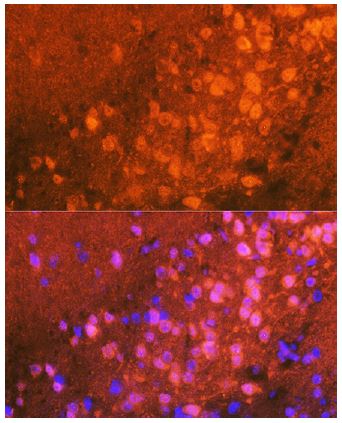
Immunofluorescence analysis of mouse brain using JNK1/2/3 Rabbit mAb at dilution of 1:100 (40x lens). Blue: DAPI for nuclear staining.

No documents available.