
NAPSA Rabbit Polyclonal Antibody
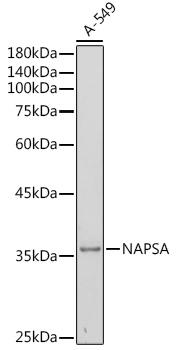
Western blot analysis of extracts of A-549 cells, using NAPSA antibody at 1:500 dilution. Secondary antibody: HRP Goat Anti-Rabbit IgG (H+L) at 1:10000 dilution. Lysates/proteins: 25ug per lane. Blocking buffer: 3% nonfat dry milk in TBST. Detection: ECL West Pico Plus. Exposure time: 180s.
| Catalog Number: | AB-84404 |
| Conjugate: | Unconjugated |
| Size: | 100ug |
| Concentration: | 1mg/ml |
| Host: | Rb |
| Isotype: | IgG |
| Clone: | POLY |
| Immunogen: | Recombinant fusion protein containing a sequence corresponding to amino acids25-250 of human NAPSA. |
| Reactivity: | Hu, Ms, Rt |
| Applications: | Western Blot: 1:1000 - 1:2000Immunofluorescence: 1:50 - 1:200 |
| Molecular Weight: | 38kDa |
| Purification: | Aff. Pur. |
| Form: | Liquid |
| Synonyms: | NAPSA;KAP;Kdap;NAP1;NAPA;SNAPA;napsin-A;Napsin A |
This gene encodes a member of the peptidase A1 family of aspartic proteases. The encoded preproprotein is proteolytically processed to generate an activation peptide and the mature protease. The activation peptides of aspartic proteinases function as inhibitors of the protease active site. These peptide segments, or pro-parts, are deemed important for correct folding, targeting, and control of the activation of aspartic proteinase zymogens. The encoded protease may play a role in the proteolytic processing of pulmonary surfactant protein B in the lung and may function in protein catabolism in the renal proximal tubules. This gene has been described as a marker for lung adenocarcinoma and renal cell carcinoma.
Applications
Western Blot: 1:1000 - 1:2000Immunofluorescence: 1:50 - 1:200
Immunogen
Recombinant fusion protein containing a sequence corresponding to amino acids25-250 of human NAPSA.