p38 (phospho Thr180/Y182) rabbit Monoclonal Antibody
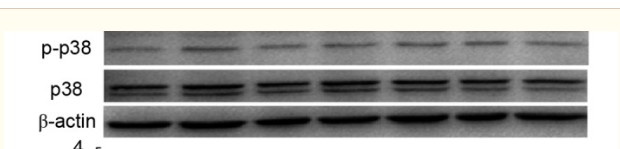
Xu, Yini, et al. "Inhibitory effects of oxymatrine on TGF‑β1‑induced
proliferation and abnormal differentiation in rat cardiac fibroblasts via thep38MAPK and ERK1/2 signaling pathways." Molecular medicine reports 16.4(2017): 5354-5362.

Xu, Yini, et al. "Inhibitory effects of oxymatrine on TGF‑β1‑induced proliferation and abnormal differentiation in rat cardiac fibroblasts via thep38MAPK and ERK1/2 signaling pathways." Molecular medicine reports 16.4(2017): 5354-5362.

Catalog Number:MAB-94216
Conjugate:unconjugated
Size:100 ug
Concentration:1 mg/ml
Host:Rabbit
Isotype:IgG
Clone:12F8
Immunogen:The antiserum was produced against synthesized peptide derived from human p38 MAPK around the phosphorylation site of Thr179 and Tyr181. AA range:151-200
Reactivity:Human;Mouse;Rat;Guineapig
Applications:IF/ICC 1:100-500;WB 1:500-2000;Flow Cyt 1:50-200;IHC-p 1:100-500;ELISA 1:5000-20000
Molecular Weight:38kD
Purification:The antibody was affinity-purified fromrabbit antiserum by affinity-chromatography using epitope-specific immunogen.
Form:liquid
Synonyms:MAPK14; CSBP; CSBP1; CSBP2; CSPB1; MXI2; SAPK2A; Mitogen-activated protein kinase 14; MAP kinase 14; MAPK 14; Cytokine suppressive anti-inflammatory drug-binding protein; CSAID-binding protein; CSBP; MAP kinase MXI2; MAX-interacting protein

The protein encoded by this gene is a member of the MAP kinase family. MAP kinases act as an integration point for multiple biochemical signals, and are involved in a wide variety of cellular processes such as proliferation, differentiation, transcription regulation and development. This kinase is activated by various environmental stresses and proinflammatory cytokines. The activation requires its phosphorylation by MAP kinase kinases (MKKs), or its autophosphorylation triggered by the interaction of MAP3K7IP1/TAB1 protein with this kinase. The substrates of this kinase include transcription regulator ATF2, MEF2C, and MAX, cell cycle regulator CDC25B, and tumor suppressor p53, which suggest the roles of this kinase in stress related transcription and cell cycle regulation, as well as in genotoxic stress response. Four alternatively spliced transcript variants of this gene encoding d

Applications

IF/ICC 1:100-500;WB 1:500-2000;Flow Cyt 1:50-200;IHC-p 1:100-500;ELISA 1:5000-20000

Immunogen

The antiserum was produced against synthesized peptide derived from human p38 MAPK around the phosphorylation site of Thr179 and Tyr181. AA range:151-200

Target Background

The protein encoded by this gene is a member of the MAP kinase family. MAP kinases act as an integration point for multiple biochemical signals, and are involved in a wide variety of cellular processes such as proliferation, differentiation, transcription regulation and development. This kinase is activated by various environmental stresses and proinflammatory cytokines. The activation requires its phosphorylation by MAP kinase kinases (MKKs), or its autophosphorylation triggered by the interaction of MAP3K7IP1/TAB1 protein with this kinase. The substrates of this kinase include transcription regulator ATF2, MEF2C, and MAX, cell cycle regulator CDC25B, and tumor suppressor p53, which suggest the roles of this kinase in stress related transcription and cell cycle regulation, as well as in genotoxic stress response. Four alternatively spliced transcript variants of this gene encoding d

Synonyms:MAPK14; CSBP; CSBP1; CSBP2; CSPB1; MXI2; SAPK2A; Mitogen-activated protein kinase 14; MAP kinase 14; MAPK 14; Cytokine suppressive anti-inflammatory drug-binding protein; CSAID-binding protein; CSBP; MAP kinase MXI2; MAX-interacting protein

Storage

-20°C/1 year

Buffer

Liquid in PBS containing 50% glycerol, 0.5%BSAand0.02% sodium azide.

Xu, Yini, et al. "Inhibitory effects of oxymatrine on TGF‑β1‑induced proliferation and abnormal differentiation in rat cardiac fibroblasts via thep38MAPK and ERK1/2 signaling pathways." Molecular medicine reports 16.4(2017): 5354-5362.

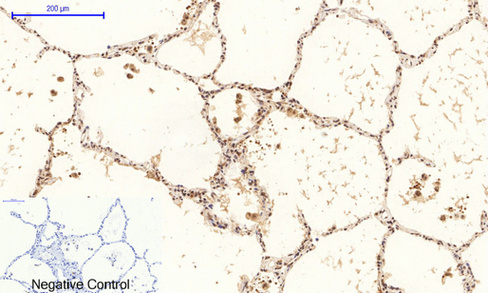
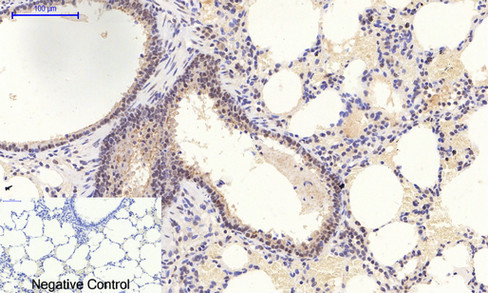
Immunohistochemical analysis of paraffin-embedded Human-lung tissue.1,p38 (phospho Thr180/Y182) Antibody was diluted at 1:200(4°C,overnight). 2, Sodium citrate pH 6.0 was used for antibody retrieval(>98°C,20min). 3,Secondary antibody was diluted at 1:200(room tempeRature, 30min). Negative control was used by secondary antibodyonly.

Immunohistochemical analysis of paraffin-embedded Rat-lung tissue. 1,p38 (phospho Thr180/Y182) Antibody was diluted at 1:200(4°C,overnight). 2, Sodium citrate pH 6.0 was used for antibody retrieval(>98°C,20min). 3,Secondary antibody was diluted at 1:200(room tempeRature, 30min). Negative control was used by secondary antibody only.

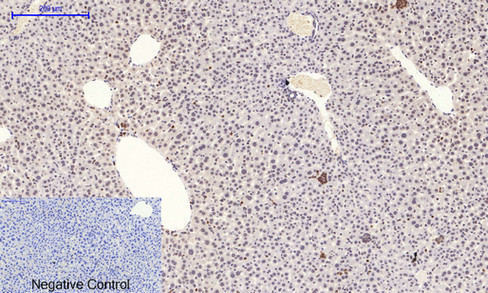
Immunohistochemical analysis of paraffin-embedded Mouse-liver tissue.1,p38 (phospho Thr180/Y182) Antibody was diluted at 1:200(4°C,overnight). 2, Sodium citrate pH 6.0 was used for antibody retrieval(>98°C,20min). 3,Secondary antibody was diluted at 1:200(room tempeRature, 30min). Negative control was used by secondary antibody only.

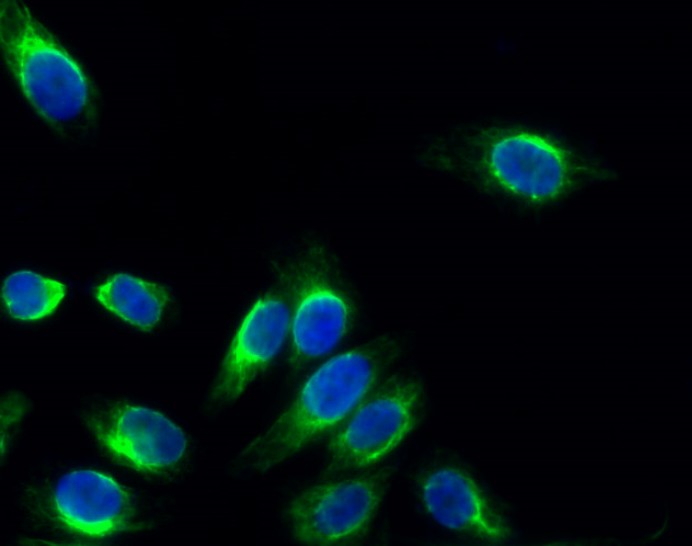
Immunofluorescence analysis of Hela cell. 1,p38 (phospho Thr180/Y182) Polyclonal Antibody(green) was diluted at 1:200(4° overnight). 2, Goat Anti Rabbit Alexa Fluor 488 was diluted at 1:1000(room temperature, 50min). 3 DAPI(blue) 10min.

No documents available.