
Phospho-AKT1 (S473)

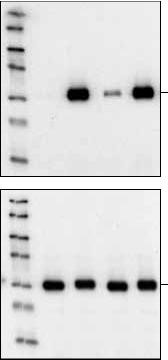
Western blot analysis of extracts from untreated or PDGF¬treated NIH/3T3 cells, pretreated with wortmannin and/ or rapamycin as indicated, using Phospho-Akt (Ser473) (193H12) Rabbit mAb (upper) or Akt Antibody  (lower).

Western blot analysis of extracts from untreated or PDGF¬treated NIH/3T3 cells, pretreated with wortmannin and/ or rapamycin as indicated, using Phospho-Akt (Ser473) (193H12) Rabbit mAb (upper) or Akt Antibody (lower).

Catalog Number:MAB-94266
Conjugate:Unconjugated
Size:100 ul
Concentration:1mg/ml
Host:Rb
Isotype:IgG
Clone:193H12
Immunogen:Peptide surrounding pSer-473 at the C-terminal sequence of human AKT protein
Reactivity:Hu, Ms, Rt
Applications:Western blotting 1:1000 Immunoprecipitation 1:200 Immunofluorescence (IF-IC) 1:200 Immuncytochemistry 1:200
Molecular Weight:60 kDa
Purification:Monoclonal antibody is produced by immunizing animals with a synthetic phosphopeptide corresponding to residues around Ser473 of mouse Akt.
Form:liquid
Synonyms:AKT;CWS6;PKB;PKB-ALPHA;PRKBA;RAC;RAC-ALPHA;AKT1

Applications

Western blotting 1:1000 Immunoprecipitation 1:200 Immunofluorescence (IF-IC) 1:200 Immuncytochemistry 1:200

Immunogen

Peptide surrounding pSer-473 at the C-terminal sequence of human AKT protein
Target Background

Akt, also referred to as PKB or Rac, plays a critical role in controlling survival and apoptosis (1-3). This protein kinase is activated by insulin and various growth and survival factors to function in a wortmannin-sensitive pathway involving PI3 kinase (2,3). Akt is activated by phospholipid binding and activation loop phosphorylation at Thr308 by PDK1 (4) and by phosphorylation within the carboxy terminus at Ser473. The previously elusive PDK2 responsible for phosphorylation of Akt at Ser473 has been identified as mammalian target of rapamycin (mTOR) in a rapamycin-insensitive complex with rictor and Sin1 (5,6). Akt promotes cell survival by inhibiting apoptosis through phosphorylation and inactivation of several targets, including Bad (7), forkhead transcription factors (8), c-Raf (9), and caspase-9. PTEN phosphatase is a major negative regulator of the PI3 kinase/Akt signaling pathway (10). LY294002 is a specific PI3 kinase inhibitor (11). Another essential Akt function is the regulation of glycogen synthesis through phosphorylation and inactivation of GSK-3α and β (12,13). Akt may also play a role in insulin stimulation of glucose transport (12). In addition to its role in survival and glycogen synthesis, Akt is involved in cell cycle regulation by preventing GSK-3β-mediated phosphorylation and degradation of cyclin D1 (14) and by negatively regulating the cyclin dependent kinase inhibitors p27 Kip1 (15)and p21 Waf1/Cip1 (16). Akt also plays acritical role in cell growth by directlyphosphorylating mTOR in a rapamycin-sensitive complex containing raptor (17). Moreimportantly, Akt phosphorylates and inactivatestuberin (TSC2), an inhibitor of mTOR within themTOR-raptor complex (18,19).Phospho-Akt (Ser473) (193H12) Rabbit mAb detects endogenous levels of Akt only when phosphorylated at Ser473.

Synonyms:AKT;CWS6;PKB;PKB-ALPHA;PRKBA;RAC;RAC-ALPHA;AKT1

Storage

Store: At +4°C for short term, at-20°C for longer term Avoid freezing and thawing cycles

Buffer

Supplied in 20 mM Tris-HCl, pH 8.0 - 100 mg/ml BSA, 0.05% sodium azide.

Western blot analysis of extracts from untreated or PDGF¬treated NIH/3T3 cells, pretreated with wortmannin and/ or rapamycin as indicated, using Phospho-Akt (Ser473) (193H12) Rabbit mAb (upper) or Akt Antibody (lower).

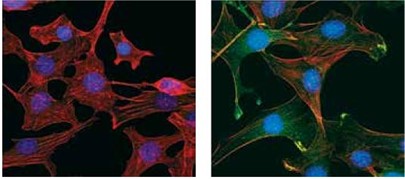
Confocal immunofluorescent analysis of C2C12 cells, U0126/LY294002/Rapamycin-treated (left) or insulin¬treated (right) using Phospho-Akt (Ser473) (193H12) Rabbit mAb (green).

No documents available.