
Phospho-Jun-(S243)

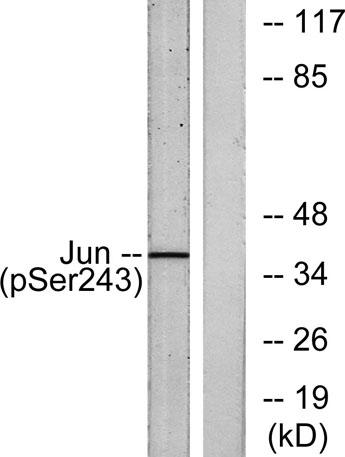
Western blot analysis of lysates from HeLa cells treated with UV, using c-Jun (Phospho-Ser243) Antibody. The lane on the right is blocked with the phospho peptide.

Western blot analysis of lysates from HeLa cells treated with UV, using c-Jun (Phospho-Ser243) Antibody. The lane on the right is blocked with the phospho peptide.

Catalog Number:ABP-0050
Conjugate:Unconjugated
Size:100 ug
Concentration:1mg/ml
Host:Rabbit
Isotype:IgG
Clone:Poly
Immunogen:The antiserum was produced against synthesized peptide derived from human c-Jun around the phosphorylation site of Ser243. AA range:210-259
Reactivity:Human;Mouse;Rat
Applications:Western Blot: 1/500 - 1/2000. Immunohistochemistry: 1/100 - 1/300                                         Immunofluorescence: 1/50-1/200
Molecular Weight:39-42kD
Purification:Affinity purification
Form:liquid
Synonyms:JUN; Transcription factor AP-1; Activator protein 1; AP1; Proto-oncogene c-Jun; V-jun avian sarcoma virus 17 oncogene homolog; p39

Applications

Western Blot: 1/500 - 1/2000. Immunohistochemistry: 1/100 - 1/300                                         Immunofluorescence: 1/50-1/200

Immunogen

The antiserum was produced against synthesized peptide derived from human c-Jun around the phosphorylation site of Ser243. AA range:210-259

Target Background

c-Jun is a member of the Jun Family containing c-Jun, JunB and JunD, and is a component of the transcription factor AP-1 (activator protein-1). AP-1 is composed of dimers of Fos, Jun and ATF family members and binds to and activates transcription at TRE/AP-1 elements (reviewed in 1). Extracellular signals including growth factors, chemokines and stress activate AP-1-dependent transcription. The transcriptional activity of c-Jun is regulated by phosphorylation at Ser63 and Ser73 through SAPK/JNK (reviewed in 2). Knock-out studies in mice have shown that c-Jun is essential for embryogenesis (3), and subsequent studies have demonstrated roles for c-Jun in various tissues and developmental processes including axon regeneration (4), liver regeneration (5) and T cell development (6). AP-1 regulated genes exert diverse biological functions including cell proliferation, differentiation, and apoptosis, as well as transformation, invasion and metastasis, depending on cell type and context (7-9). Other target genes regulate survival as well as hypoxia and angiogenesis (8,10). c-Jun has emerged as a promising therapeutic target for cancer, vascular remodeling, acute inflammation, as well as rheumatoid arthritis (11,12).

Synonyms:JUN; Transcription factor AP-1; Activator protein 1; AP1; Proto-oncogene c-Jun; V-jun avian sarcoma virus 17 oncogene homolog; p39

Storage

Store at -20℃. Avoid freeze / thaw cycles.

Buffer

Liquid in PBS containing 50% glycerol, 0.5% BSA and 0.02% sodium azide..

Western blot analysis of lysates from HeLa cells treated with UV, using c-Jun (Phospho-Ser243) Antibody. The lane on the right is blocked with the phospho peptide.

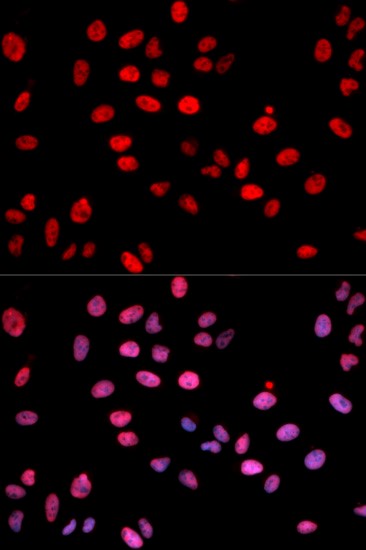
Immunofluorescence analysis of U2OS cell using c-Jun- Phospho-S243 antibody. Blue: DAPI for nuclear staining.

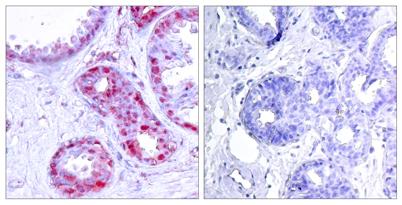
Immunohistochemistry analysis of paraffin-embedded human breast carcinoma, using c-Jun (Phospho-Ser243) Antibody. The picture on the right is blocked with the phospho peptide.

No documents available.