
Phospho-Tau (T181)

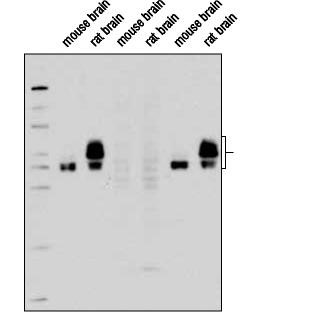
Western blot analysis of extracts from mouse and rat brain using Phospho-Tau (Thr181) (D9F4G) Rabbit mAb. The phospho¬specificity of Phospho-Tau (Thr181) (D9F4G) Rabbit mAb was verified by peptide blocking using a phosphopeptide or non-phosphopeptide targeting residue Thr181.

Western blot analysis of extracts from mouse and rat brain using Phospho-Tau (Thr181) (D9F4G) Rabbit mAb. The phospho¬specificity of Phospho-Tau (Thr181) (D9F4G) Rabbit mAb was verified by peptide blocking using a phosphopeptide or non-phosphopeptide targeting residue Thr181.

Catalog Number:MAB-94237
Conjugate:Unconjugated
Size:100 ug
Concentration:1mg/ml
Host:Rb
Isotype:IgG
Clone:D9F4G
Reactivity:Hu
Applications:Western blotting 1:1000 Immunohistochemistry (Paraffin) 1:100† Unmasking buffer: Citrate †Optimal IHC dilutions determined using SignalStain® Boost IHC Detection Reagent.
Molecular Weight:50-80 kDa
Purification:Monoclonal antibody is produced by immunizing animals with a synthetic phosphopeptide corresponding to residues surrounding Thr181 of human Tau protein.
Form:liquid

Applications

Western blotting 1:1000 Immunohistochemistry (Paraffin) 1:100† Unmasking buffer: Citrate †Optimal IHC dilutions determined using SignalStain® Boost IHC Detection Reagent.

Target Background

Tau is a heterogeneous microtubule-associated protein that promotes and stabilizes microtubule assembly, especially in axons. Six isoforms with different amino-terminal inserts and different numbers of tandem repeats near the carboxy terminus have been identified, and tau is hyperphosphorylated at approximately 25 sites by Erk, GSK-3, and CDK5 (1,2). Phosphorylation decreases the ability of tau to bind to microtubules. Neurofibrillary tangles are a major hallmark of Alzheimer’s disease; these tangles are bundles of paired helical filaments composed of hyperphosphorylated tau. In particular, phosphorylation at Ser396 by GSK-3 or CDK5 destabilizes microtubules. Furthermore, research studies have shown that inclusions of tau are found in a number of other neurodegenerative diseases, collectively known as tauopathies (1,3). The cerebrospinal fluid concentration of Tau phosphorylated at Thr181 has been proposed to be a biomarker for the study of neurodegenerative disorders (4).Phospho-Tau (Thr181) (D9F4G) Rabbit mAb recognizes endogenous levels of Tau protein only when phosphorylated at Thr181

Storage

Store at -20℃. Avoid freeze / thaw cycles.

Buffer

Supplied in 10 mM sodium HEPES (pH 7.5), 150 mM NaCl, 100 µg/ml BSA, 50% glycerol and less than 0.02% sodium azide.

Western blot analysis of extracts from mouse and rat brain using Phospho-Tau (Thr181) (D9F4G) Rabbit mAb. The phospho¬specificity of Phospho-Tau (Thr181) (D9F4G) Rabbit mAb was verified by peptide blocking using a phosphopeptide or non-phosphopeptide targeting residue Thr181.

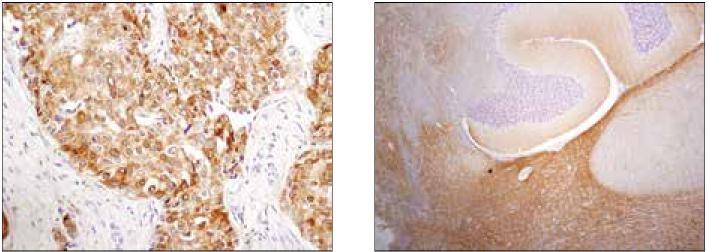
Immunohistochemical analysis of paraffin-embedded human breast carcinoma using Phospho-Tau (Thr181) (D9F4G) Rabbit mAb. Immunohistochemical analysis of paraffin-embedded mouse brain using Phospho-Tau (Thr181) (D9F4G) Rabbit mAb.

No documents available.