Stat6 (phospho Tyr641) Rabbit Polyclonal Antibody
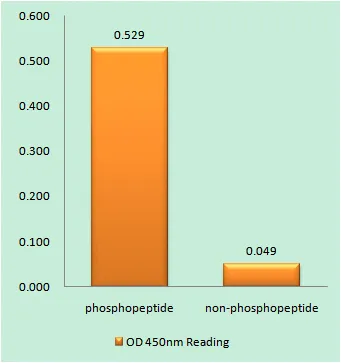
Enzyme-Linked Immunosorbent Assay (Phospho-ELISA) for Immunogen Phosphopeptide (Phospho-left) and Non-Phosphopeptide (Phospho-right), using STAT6 (Phospho-Tyr641) Antibody
| Catalog Number: | ABN05490 |
| Conjugate: | Unconjugated |
| Size: | 100ul |
| Concentration: | 1mg/ml |
| Host: | Rabbit |
| Isotype: | IgG |
| Clone: | POLY |
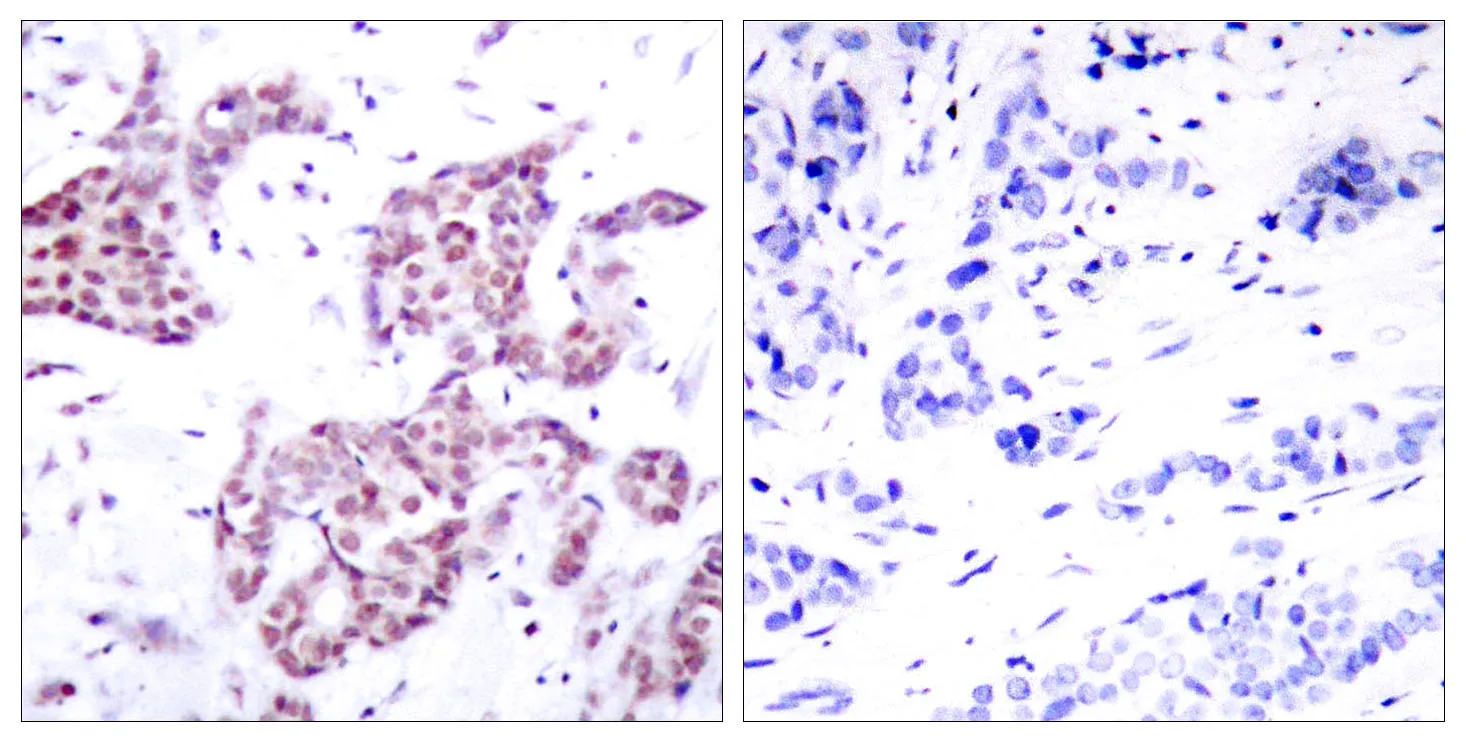
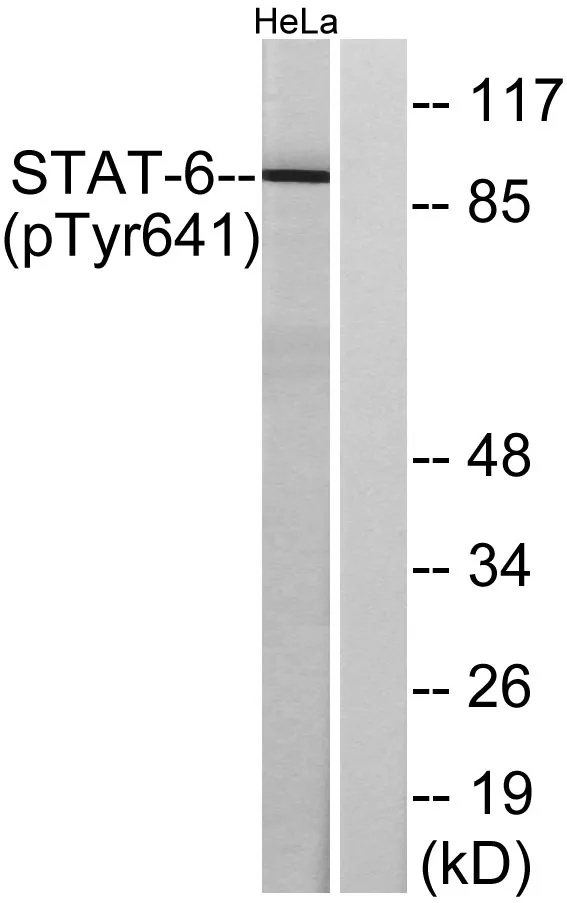
| Immunogen: | Phosphopeptide (Phospho-left) and Non-Phosphopeptide (Phospho-right), using STAT6 (Phospho-Tyr641) Antibody Immunohistochemistry analysis of paraffin-embedded human breast carcinoma, using STAT6 (Phospho-Tyr641) Antibody. The picture on the right is blocked with the phospho peptide. Western blot analysis of lysates from HeLa cells treated with IL-4, using STAT6 (Phospho-Tyr641) Antibody. The lane on the right is blocked with the phospho peptide. |
| Reactivity: | Human,Mouse,Rat |
| Applications: | WB 1:500-1:2000,IHC 1:100-1:300,ICC/IF 1:50-1:200,ELISA 1:5000-1:20000 |
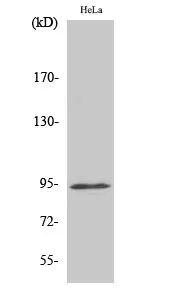
| Molecular Weight: | 94kDa |
| Purification: | Affinity purification |
| Form: | liquid |
| Synonyms: | STAT6; Signal transducer and activator of transcription 6; IL-4 Stat |
The protein encoded by this gene is a member of the STAT family of transcription factors. In response to cytokines and growth factors, STAT family members are phosphorylated by the receptor associated kinases, and then form homo- or heterodimers that translocate to the cell nucleus where they act as transcription activators. This protein plays a central role in exerting IL4 mediated biological responses. It is found to induce the expression of BCL2L1/BCL-X(L), which is responsible for the anti-apoptotic activity of IL4. Knockout studies in mice suggested the roles of this gene in differentiation of T helper 2 (Th2) cells, expression of cell surface markers, and class switch of immunoglobulins. Alternative splicing results in multiple transcript variants.[provided by RefSeq, May 2010],function:Carries out a dual function: signal transduction and activation of transcription. Involved in interleukin-4 signalling.,PTM:Tyrosine phosphorylated following stimulation by IL-4 and IL-3.,similarity:Belongs to the transcription factor STAT family.,similarity:Contains 1 SH2 domain.,subcellular location:Translocated into the nucleus in response to phosphorylation.,subunit:Forms a homodimer or a heterodimer with a related family member (By similarity). Interacts with NCOA1 via its C-terminal LXXLL motif.,
Applications
WB 1:500-1:2000,IHC 1:100-1:300,ICC/IF 1:50-1:200,ELISA 1:5000-1:20000
Immunogen
Phosphopeptide (Phospho-left) and Non-Phosphopeptide (Phospho-right), using STAT6 (Phospho-Tyr641) Antibody Immunohistochemistry analysis of paraffin-embedded human breast carcinoma, using STAT6 (Phospho-Tyr641) Antibody. The picture on the right is blocked with the phospho peptide. Western blot analysis of lysates from HeLa cells treated with IL-4, using STAT6 (Phospho-Tyr641) Antibody. The lane on the right is blocked with the phospho peptide.