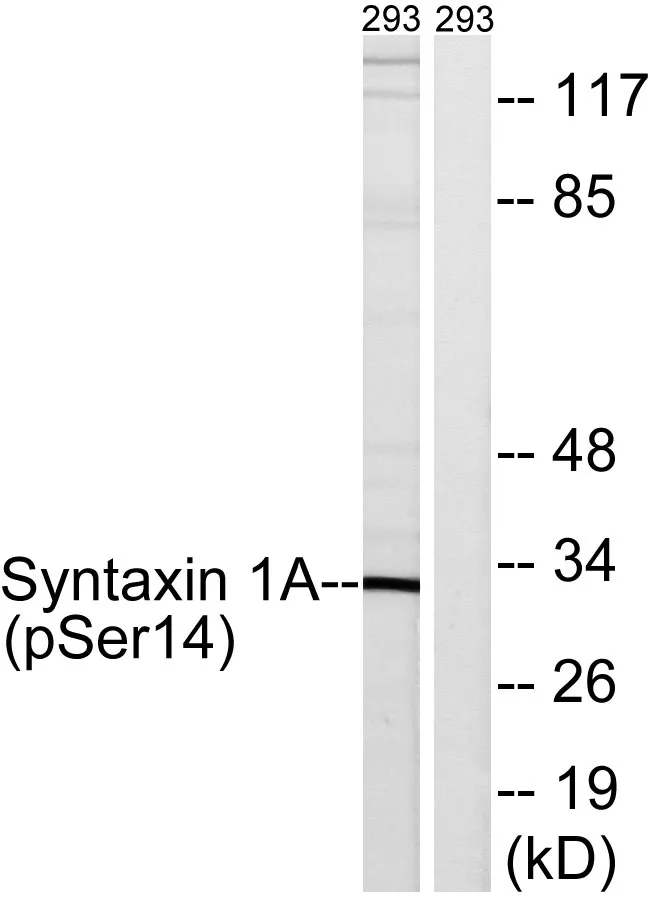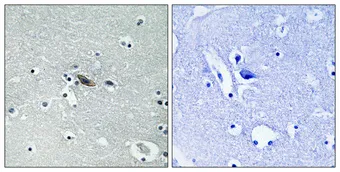
Syntaxin 1 (phospho Ser14) Rabbit Polyclonal Antibody
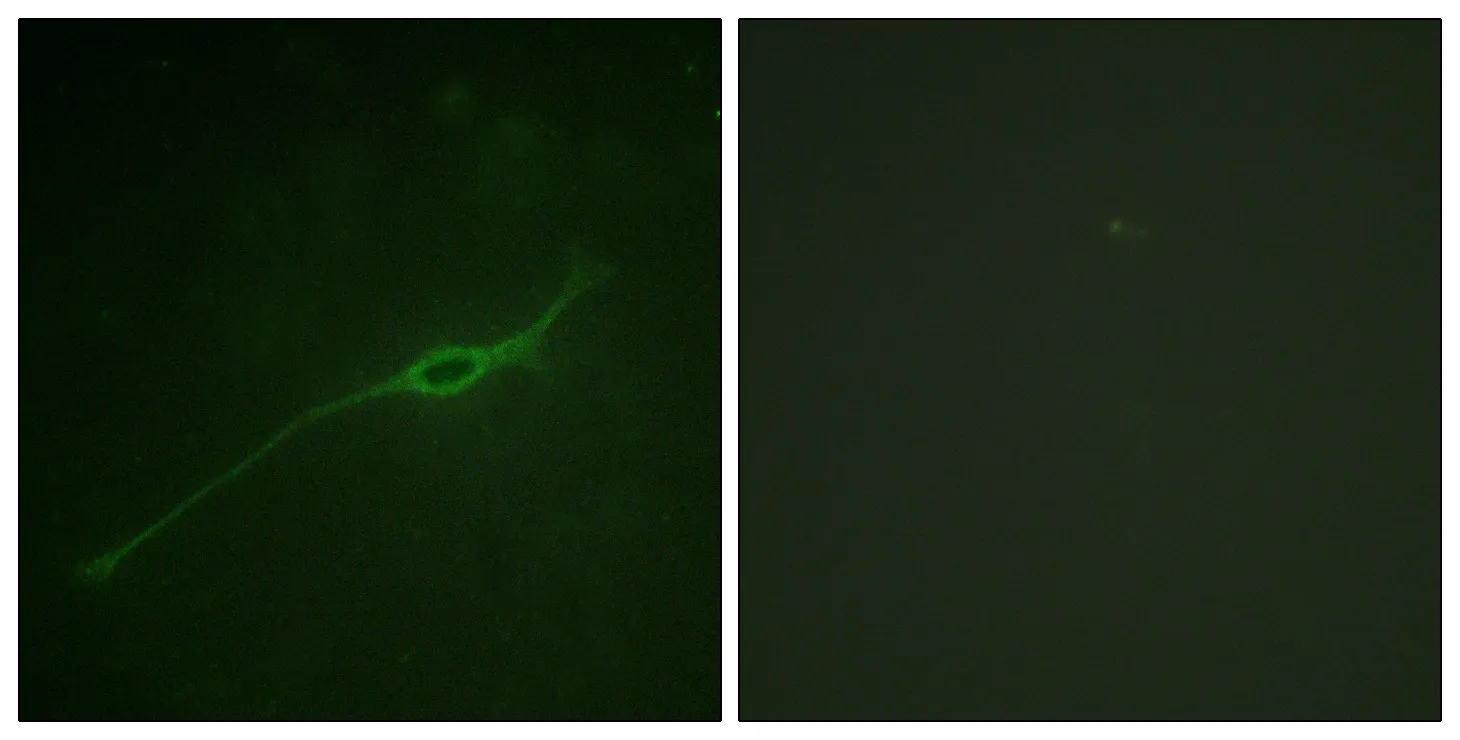
Immunofluorescence analysis of NIH/3T3 cells, using Syntaxin 1A (Phospho-Ser14) Antibody. The picture on the right is blocked with the phospho peptide.
| Catalog Number: | ABN05508 |
| Conjugate: | Unconjugated |
| Size: | 100ul |
| Concentration: | 1mg/ml |
| Host: | Rabbit |
| Isotype: | IgG |
| Clone: | POLY |
| Immunogen: | The antiserum was produced against synthesized peptide derived from human Syntaxin 1A around the phosphorylation site of Ser14. AA range:1-50 |
| Reactivity: | Human,Mouse,Rat |
| Applications: | WB 1:500-1:2000,IHC 1:100-1:300,ICC/IF 1:200-1:1000,ELISA 1:5000-1:20000 |
| Molecular Weight: | 35kDa |
| Purification: | Affinity purification |
| Form: | liquid |
| Synonyms: | STX1A; STX1; Syntaxin-1A; Neuron-specific antigen HPC-1 |
This gene encodes a member of the syntaxin superfamily. Syntaxins are nervous system-specific proteins implicated in the docking of synaptic vesicles with the presynaptic plasma membrane. Syntaxins possess a single C-terminal transmembrane domain, a SNARE [Soluble NSF (N-ethylmaleimide-sensitive fusion protein)-Attachment protein REceptor] domain (known as H3), and an N-terminal regulatory domain (Habc). Syntaxins bind synaptotagmin in a calcium-dependent fashion and interact with voltage dependent calcium and potassium channels via the C-terminal H3 domain. This gene product is a key molecule in ion channel regulation and synaptic exocytosis. Alternatively spliced transcript variants encoding different isoforms have been found for this gene.[provided by RefSeq, Sep 2009],disease:Haploinsufficiency of STX1A may be the cause of certain cardiovascular and musculo-skeletal abnormalities observed in Williams-Beuren syndrome (WBS), a rare developmental disorder. It is a contiguous gene deletion syndrome involving genes from chromosome band 7q11.23.,function:Potentially involved in docking of synaptic vesicles at presynaptic active zones. May play a critical role in neurotransmitter exocytosis.,similarity:Belongs to the syntaxin family.,similarity:Contains 1 t-SNARE coiled-coil homology domain.,subunit:Part of the SNARE core complex containing SNAP25, VAMP2 and STX1A. This complex binds to CPLX1. Binds SYTL4 and STXBP6. Found in a ternary complex with STX1A and SNAP25. Interacts with OTOF (By similarity). Found in a complex with VAMP8 and SNAP23. Interacts with VAPA and SYBU.,tissue specificity:Isoform 1 is highly expressed in embryonic spinal chord and ganglia and in adult cerebellum and cerebral cortex. Isoform 2 is expressed in heart, liver, fat, skeletal muscle, kidney and brain.,
Applications
WB 1:500-1:2000,IHC 1:100-1:300,ICC/IF 1:200-1:1000,ELISA 1:5000-1:20000
Immunogen
The antiserum was produced against synthesized peptide derived from human Syntaxin 1A around the phosphorylation site of Ser14. AA range:1-50